- admin
- Published:
- Last updated:
- Website Guides
- 6
- 0
Introduction
Wix has over 282 million registered users globally and powers more than 8.5 million live websites as of 2026. For a platform built on the promise of simple, no-code website creation, those numbers are genuinely impressive. But having millions of users does not mean Wix is the right platform for everyone, and a growing share of those users are actively searching for wix alternatives that better fit their needs.
The reasons are well-documented. Wix locks users into their chosen template after publishing, which means switching to a different design requires rebuilding the entire site from scratch. Renewal pricing increases significantly after the first promotional year. The $17 per month Light plan does not include ecommerce, bookings, or analytics tools, which means the Core plan at $29 per month is the practical starting point for most business websites. Third-party app costs stack up quickly on top of that base price. And for users who want to move to a different platform later, Wix's closed system makes that transition genuinely painful.
In 2026, there are better options for nearly every use case. Whether the priority is a completely free plan with no platform branding, stronger design quality, better SEO performance, purpose-built ecommerce, or full data ownership, there is a Wix alternative that fits.
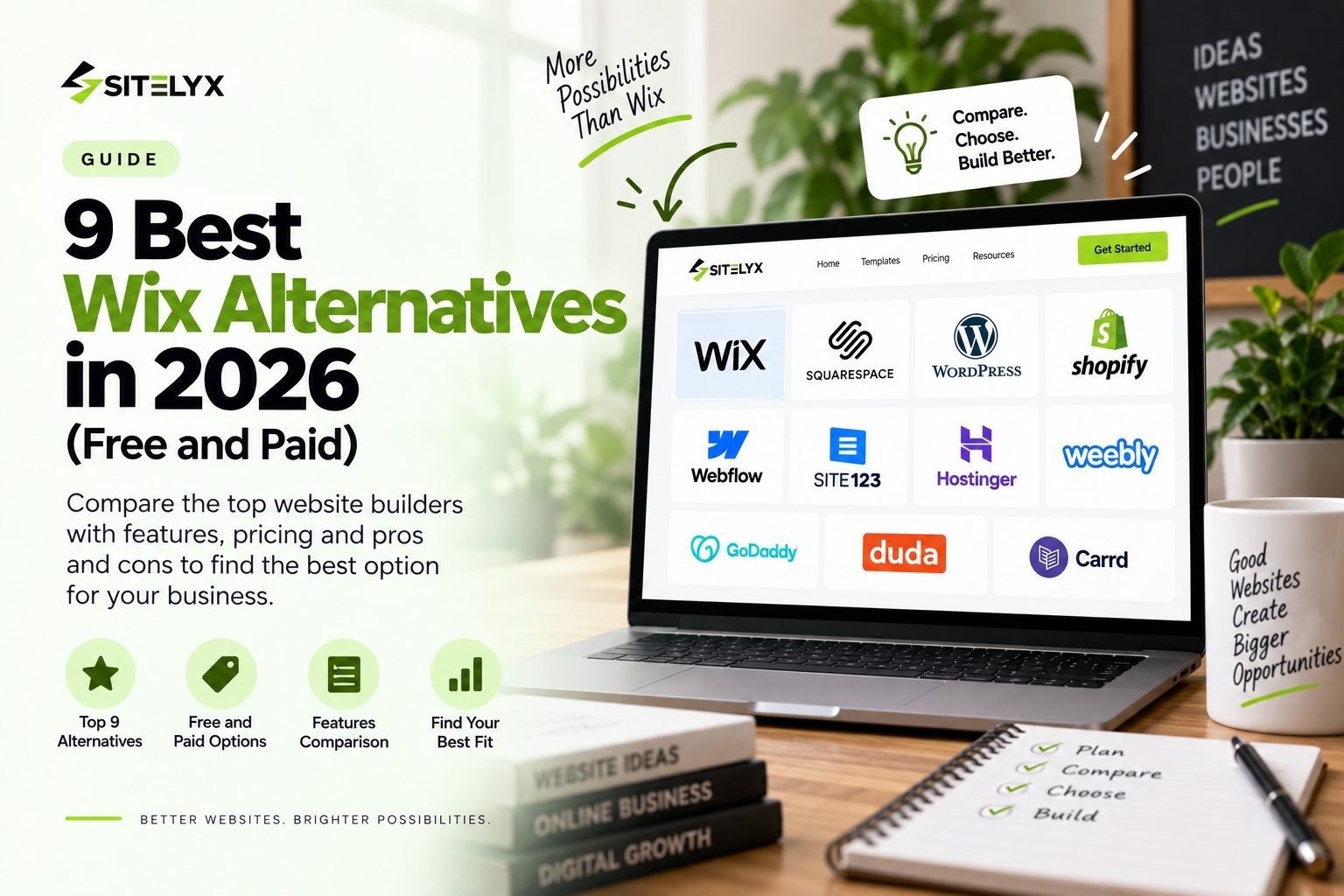
This guide covers 9 of the best Wix alternatives in 2026, both free and paid, ranked and reviewed by use case so you can choose the right platform before you invest time building a site on the wrong one.
Why People Look for Wix Alternatives
Understanding the specific limitations of Wix makes it easier to identify which alternative solves the problem that matters most for a given use case.
Template lock-in after publishing
Once a Wix website is published, switching to a different template requires rebuilding the entire website from scratch. This inflexibility frustrates users whose design needs evolve as their business grows. It is one of the most commonly cited reasons users research alternatives before starting to build rather than after.
Pricing that scales quickly beyond the advertised entry price
Wix paid plans run from $17 per month on the Light plan to $159 per month on Business Elite when billed annually.how Wix pricing compares across all five plans in 2026.The Light plan does not include ecommerce, booking tools or analytics. The Core plan at $29 per month is the true starting point for most business websites. Adding paid apps from the Wix App Market for marketing, CRM, or advanced SEO pushes the effective monthly cost well above the plan price.
Page speed limitations
Wix's JavaScript-heavy framework has historically produced lower Core Web Vitals scores compared to platforms like Webflow or Squarespace. Wix has improved its performance significantly in recent years, reaching a 71 to 75% Core Web Vitals pass rate in 2026, which is the highest among major website builders.Why Wix page speed affects SEO rankings and Core Web Vitals scores.However, for users in competitive niches where every performance point matters for SEO, alternatives like Webflow and WordPress still offer better raw output quality.
Limited design flexibility at advanced levels
Wix templates are polished and cover a wide range of styles, but the editing system operates within constraints. Users who want pixel-perfect design control, clean exportable code, or a layout system that maps to real CSS properties consistently hit walls that only a platform like Webflow or self-hosted WordPress can remove.
No data portability
Wix is a closed platform. If a user decides to move to another platform, the site design and structure cannot be exported or transferred. Content such as text and images can be manually copied but the website itself is not portable, which represents a meaningful long-term risk for businesses that want to maintain independence from a single platform.
How We Selected These Wix Alternatives
The 9 platforms in this guide were selected based on the following criteria evaluated for 2026 use cases:
- Ease of use for non-technical users
- Design quality and template flexibility
- SEO tools and real-world performance on Core Web Vitals
- Pricing transparency including true cost after apps and plan renewals
- Free plan availability and quality
- Ecommerce capability where relevant to the platform's primary use case
- Scalability as the website and business grows over time
- Specific use cases where each platform outperforms Wix
Each platform is reviewed with a stated "best for" recommendation and a clear limitation relative to Wix so readers can make an informed decision rather than switching from one unsuitable platform to another.
Quick Comparison: 9 Best Wix Alternatives at a Glance
| Platform | Best For | Free Plan | Starting Price | Key Advantage Over Wix |
|---|---|---|---|---|
| Sitelyx | Small businesses, CMS users | Yes | Free | Full CMS, free subdomain, no platform branding on free tier |
| Squarespace | Design quality, service businesses | No (trial) | $16/month | Better design consistency, stronger overall brand presentation |
| WordPress.org | Full customization, bloggers | No (hosting needed) | ~$3/month hosting | Unlimited plugins, full data ownership, no platform lock-in |
| Webflow | Designers, agencies | Yes (limited) | $14/month | Clean code output, strong Core Web Vitals performance |
| Shopify | Ecommerce | No | $29/month | Purpose-built for selling, 8,000 plus apps |
| Hostinger | Budget users | No | $2.99/month | Cheapest paid alternative with AI tools included |
| Weebly | First-time builders | Yes | $10/month | Simpler than Wix for basic websites |
| Ghost | Bloggers, publishers | No | $9/month | Fast performance-first publishing platform |
| GoDaddy | Speed of setup | No | $9.99/month | Fastest time from signup to live website |
Sitelyx is the only platform in this comparison that offers a genuinely full CMS website on a free plan with no monthly cost and no platform branding on the visitor-facing website.
1. Sitelyx Best Free Wix Alternative for Small Businesses and CMS Users
For users who want a professional website without paying a monthly subscription and without dealing with Wix's template lock-in, Sitelyx is the strongest starting point in 2026.
What Sitelyx is
Sitelyx is a hosted website builder and content management system that creates a separate tenant website for each user immediately upon signup. The website receives a free subdomain right away, for example yourbusiness.sitelyx.co, which is live on the internet from day one. All website management happens from the Sitelyx admin panel at /admin-home with no hosting setup, no coding, and no developer required at any stage.
Why Sitelyx beats Wix in specific areas
The most meaningful advantage Sitelyx has over Wix is a free plan that actually works for professional use. Wix's free plan forces prominent Wix branding on every visitor-facing page and uses a subdomain format that signals an unfinished or unprofessional web presence. Sitelyx's free plan does not add platform branding to the visitor-facing website, which makes it immediately usable as a professional online presence from the first day without paying anything.
Sitelyx also has no template lock-in because content is managed through the CMS admin panel rather than being embedded into a visual template structure. The pages, content, and media library exist independently of the design template, which means updating the design later does not require rebuilding all the content.
Key features available on the Sitelyx free plan
- Pages: Create and edit any number of pages from the Pages section inside /admin-home, including homepage, services, about, contact, and any custom pages the business needs
- Blog: Publish content and optimize every individual post with its own meta title and meta description for organic search visibility
- Media Library: Upload and manage all photos, logos, and other assets centrally from /admin-home for use across all pages and posts
- SEO Settings: Set a unique meta title and meta description for every page and blog post, add image alt text, and maintain a clean URL structure
- Navigation Menus: Fully customizable navigation links managed from the Menus section inside /admin-home
- Booking and ordering embeds: Any third-party booking, scheduling, or ordering widget can be embedded into any page through the page editor without coding
What this means compared to Wix
A user who needs a business website with a blog, SEO-optimized pages, and a contact form can build and maintain a complete professional web presence on Sitelyx at zero monthly cost. The equivalent on Wix requires at minimum the $17 per month Light plan for a custom domain and no Wix branding, and the $29 per month Core plan for analytics and booking tools.
Pricing
Free plan with no credit card required. Upgraded plans unlock custom domain support and additional features. View the full Sitelyx pricing and free plan details.
Best for: Small business owners, freelancers, bloggers, local service businesses, consultants, portfolio sites, and anyone who wants a professional CMS website with SEO controls and zero monthly cost without Wix's template lock-in or escalating app fees.
Limitation compared to Wix: Sitelyx does not include a native email marketing suite, built-in CRM, or native booking calendar with payment processing in the way Wix Ascend provides these tools. Booking, ordering, and scheduling functionality can be added to any Sitelyx page via third-party embeds, but users who specifically need everything managed on one platform without embedding third-party tools will find Wix's integrated suite more convenient.
Build your website for free on Sitelyx and get a professional CMS website live on a free subdomain today.
2. Squarespace: Best Wix Alternative for Design Quality
Squarespace is consistently ranked the best overall Wix alternative across multiple 2026 comparison guides, and that consensus is earned. The comparison between Wix and Squarespace is often described as Mac versus PC: Squarespace is curated, design-led, and produces visually consistent results with minimal effort, while Wix offers more freedom but also more potential for inconsistency.
Squarespace has approximately 160 templates compared to Wix's 800 plus, but the quality difference per template is significant. Every Squarespace template is modern, mobile-first, and professionally designed. The platform's structured editor makes it harder to break a design accidentally, which is a real advantage for non-technical users who want polished results without design expertise.
Squarespace Scheduling, formerly known as Acuity, provides native appointment booking with payment processing included across all paid plans. Native ecommerce is available on all paid plans without requiring an upgrade the way Wix requires the Core plan. Email marketing, SEO controls, and a blog are all included without third-party apps.
Pricing: Plans from $16 per month. No free plan, though a 14-day free trial is available. Ecommerce on all paid plans from the entry-level price.
Best for: Service businesses, creative professionals, photographers, consultants, interior designers, and anyone for whom the visual quality of the website is a direct signal of their professional credibility and the primary driver of client decisions.
Limitation versus Wix: Fewer templates and a more structured editor mean less creative freedom for users who want to experiment with unusual layouts. No free plan means a monthly commitment from day one. Total cost rises with Squarespace Scheduling and advanced ecommerce features.
3. WordPress.org: Best Wix Alternative for Full Customization
43.5% of all websites on the internet run on WordPress in 2026, making it the most widely used content management system in the world by a significant margin. That dominance is not accidental. Self-hosted WordPress gives complete data ownership, access to more than 60,000 plugins covering every possible website functionality, full code access, and the ability to move to any hosting provider at any time without platform permission.
For users who have outgrown Wix's closed platform and want a ceiling that essentially does not exist, WordPress.org is the right answer. WooCommerce turns any WordPress site into a fully functional ecommerce store. Yoast and RankMath provide deep technical SEO controls that go well beyond what Wix's SEO tools can offer. Every major third-party service has a WordPress integration, and the plugin ecosystem means the platform can grow to any level of complexity without requiring a platform switch.
The primary difference from Wix is that WordPress requires the user to select and manage their own hosting, which adds a layer of responsibility that Wix handles automatically as a fully hosted platform.
Pricing: WordPress software is free. Quality shared hosting starts at approximately $3 to $5 per month. A premium theme typically costs $50 to $100 as a one-time purchase. Key plugins range from free to $100 per year. Total effective cost typically runs $10 to $25 per month for a well-equipped WordPress site.
Best for: Bloggers, content-heavy businesses, news publishers, ecommerce operations, developers, agencies managing client sites, and anyone who wants full ownership of their data and unlimited customization potential.
Limitation versus Wix: A steeper learning curve than Wix. Requires selecting and managing hosting, security plugins, backup tools, and software updates independently. Not beginner-friendly without investing time in learning the platform. Technical issues require troubleshooting rather than contacting a single support team.
4. Webflow: Best Wix Alternative for Designers and Agencies
Webflow occupies a unique position in the website builder market. It is built for users who want complete creative control without writing code, targeting the gap between beginner builders like Wix and fully custom developer builds. Its visual builder maps directly to CSS and HTML, giving designers the ability to control exactly how every element looks and behaves at every screen size.
The performance advantage over Wix is measurable and meaningful. Webflow's clean code output consistently achieves higher Core Web Vitals scores than Wix's JavaScript-heavy output,what Core Web Vitals are and why they affect website rankings,which translates into faster page loading times and a potential SEO advantage in competitive niches. Webflow sites are hosted on Fastly CDN, which is bundled into every site plan.
The built-in CMS handles dynamic content such as blog posts, portfolio entries, team member profiles, and product listings without needing a plugin or third-party tool. Forms, SEO settings, hosting, and CMS are all native to the platform. Code export capability lets agencies hand off clean, production-ready code to clients or deploy independently.
Pricing: Free plan available on a webflow.io subdomain with up to two pages. Paid site plans from $14 per month for basic static sites. CMS features start at $23 per month. Ecommerce from $29 per month.
Best for: Web designers, creative agencies, startups building design-forward products, and any team that wants professional-grade performance and pixel-perfect design control without managing a development server.
Limitation versus Wix: Webflow has a genuinely steep learning curve compared to Wix. The visual interface is powerful but requires time to understand, making it unsuitable for users who want the simplest possible path to a live website. Native ecommerce is functional but more limited in scope than Shopify for high-volume selling.
5. Shopify: Best Wix Alternative for Ecommerce
If selling products online is the primary purpose of the website, Shopify is the strongest alternative to Wix in 2026 and it is not particularly close. Shopify is purpose-built for ecommerce from the ground up, which means every feature, every tool, and every integration exists to support the buying and selling experience rather than being added to a general-purpose website builder as a secondary feature.
More than 8,000 apps in the Shopify App Store cover every ecommerce need: inventory management, multi-channel selling across Amazon, TikTok Shop, Instagram, and in-person POS, abandoned cart recovery, subscription billing, product reviews, loyalty programs, and advanced shipping rules. Shopify Payments removes payment processor complexity. Multi-currency selling and international market tools are built in for businesses selling globally.
Where Wix requires the $29 per month Core plan to unlock basic ecommerce and scales rapidly in cost from there, Shopify is optimized specifically for the selling use case at every price tier.
Pricing: No free plan. Plans from $29 per month (Basic), $79 per month (Shopify), and $299 per month (Advanced) billed annually. A three-day free trial is available. The 2.9% plus $0.30 per transaction fee on Basic drops with higher plans.
Best for: Ecommerce businesses at any scale, product-based brands, dropshippers, businesses with in-person and online selling channels, and any organization where online selling is the core function of the website.
Limitation versus Wix: Shopify is overkill and overpriced for service businesses, portfolios, blogs, and any website where selling products is not the primary activity. The monthly cost is higher than Wix for equivalent non-ecommerce functionality.
6. Hostinger Website Builder: Best Cheap Wix Alternative
Hostinger is the most affordable alternative to Wix among paid website builder platforms in 2026. Its AI-powered website builder generates a complete starting site from a brief business description, making the setup process extremely fast even for users with no design or technical background.
AI content generation, AI image creation, and AI heatmap analysis tools are all included at a price point where Wix charges significantly more for fewer AI capabilities. The platform includes web hosting, an SSL certificate, and a domain name in a single low monthly payment, removing the need to manage hosting separately.
Template selection is more limited than Wix's 800 plus options, but the available templates are clean and functional for most small business and personal website use cases.
Pricing: From approximately $2.99 to $9.99 per month depending on the plan and promotional pricing. No meaningful free plan for professional use. The effective renewal price after the promotional period is higher than the advertised entry price.
Best for: Budget-conscious small business owners, personal websites, freelancer portfolios, and anyone who wants the lowest possible monthly website cost without sacrificing core website functionality and AI-assisted setup.
Limitation versus Wix: The entry-level plan limits users to only five website pages, which is extremely restrictive for any business with more than the most basic content needs. Template variety is much more limited than Wix. Advanced design customization is more constrained. Renewal prices are higher than the advertised entry price.
7. Weebly: Best Simple Wix Alternative for Beginners
Weebly, now owned by Square, is often described as a simplified version of Wix. It has fewer features, fewer templates, and less customization capability, but those are features rather than bugs for certain users. A first-time website builder who feels overwhelmed by Wix's extensive feature set and hundreds of app options may find Weebly's more focused approach genuinely easier to navigate.
Weebly's drag-and-drop editor is arguably simpler and more intuitive than Wix for users who want a basic business or personal website without choosing between dozens of competing features and settings. The integration with Square POS makes Weebly a natural choice for brick-and-mortar businesses that want to connect their in-person and online selling in a single ecosystem.
eCommerce is available on all Weebly plans including the free tier, though the free plan limits selling to physical products only and includes prominent Weebly branding.
Pricing: Free plan with limited features and Weebly branding. Paid plans from $10 per month for personal use and $12 per month for professional sites.
Best for: First-time website builders, personal websites, small local businesses, and shops already using Square POS that want to extend into online selling without learning a new ecosystem.
Limitation versus Wix: Significantly fewer templates, much less design flexibility, and a development roadmap that has slowed considerably since the Square acquisition. Advanced marketing tools, CRM, and SEO customization are more limited than Wix. Not suitable for complex websites or businesses expecting significant growth.
8. Ghost: Best Wix Alternative for Bloggers and Publishers
Ghost is a purpose-built publishing and membership platform designed for writers, bloggers, independent newsletters, and content-driven businesses. It is not a general-purpose website builder and should not be chosen for service businesses, ecommerce, or portfolios that need a wide variety of page types.
Within its target use case, Ghost is significantly stronger than Wix. Its performance is exceptional because it is architected around fast, clean publishing rather than feature-loaded general website building. Pages load faster than Wix, SEO is baked into the publishing workflow, and the content editing experience is clean and distraction-free.
Ghost's built-in newsletter and membership tools allow content creators to monetize their audience directly through paid subscriptions, access tiers, and member-only content, all without needing a third-party platform such as Patreon or Substack taking a percentage.
Ghost Pro is the hosted version. Self-hosted Ghost requires technical setup on a Node.js-compatible server but is available at the cost of hosting only.
Pricing: Ghost Pro starts at $9 per month (Starter plan for up to 500 members), $25 per month (Creator), and $50 per month (Team) billed annually. Self-hosted Ghost is free plus server costs.
Best for: Bloggers, independent journalists, newsletter creators, thought leaders, and content publishers who want a fast, focused publishing platform with built-in membership monetization and a subscription revenue model.
Limitation versus Wix: Ghost is very specifically a publishing platform. It is not suitable for ecommerce, service businesses, portfolios with complex page structures, or any website that needs a wide variety of non-blog page types. Template variety is extremely limited compared to Wix's 800 plus options.
9. GoDaddy Website Builder: Best Wix Alternative for Speed of Setup
GoDaddy's AI website builder generates a working starter website from a handful of business questions in under ten minutes, which is the fastest time from signup to live website of any platform in this comparison. For business owners who need to be online today with the minimum possible friction and the lowest number of decisions, GoDaddy delivers on that specific goal.
Built-in Google Business Profile integration helps keep business hours, address, and contact information consistent across Google Search and Maps without managing them separately. Appointment scheduling is available on some plans, and basic email marketing and social media publishing tools are included without third-party apps.
GoDaddy is also a natural choice for users who are already managing a domain name with GoDaddy and want a unified platform for domain registration, hosting, and website building.
Pricing: Plans from $9.99 per month. No meaningful free plan. Full AI-powered features require the Premium plan at $14.99 per month. SEO tools are locked behind paid plans.
Best for: Local service businesses, non-technical users for whom speed of setup is the primary consideration, and business owners who already use GoDaddy for domain management and want everything in one place.
Limitation versus Wix: Significantly less design flexibility and template customization than Wix. Not suitable for complex websites, content-heavy blogs, ecommerce at meaningful scale, or businesses that expect significant growth in website complexity. The editor feels constrained compared to Wix for users who want creative control.
Which Wix Alternative Should You Choose?
The right Wix alternative depends on the specific reason Wix is not working. Here is a direct recommendation framework based on use case.
Choose Sitelyx when you want a professional website with a free plan that includes no platform branding, full CMS access for pages and blog, SEO settings for every page, and no template lock-in. Sitelyx is the right choice for small businesses, freelancers, consultants, bloggers, and local service providers who need a complete, well-structured website without paying a monthly subscription. Build your website for free on Sitelyx.
Choose Squarespace when design quality is the primary consideration and you are willing to pay from $16 per month for a platform where every page looks polished and professional with minimal configuration effort.
Choose WordPress.org when you need unlimited customization, full data ownership, the ability to move hosting providers at will, and a platform that can scale to any level of complexity. Accept the steeper initial learning curve as the price of unlimited long-term flexibility.
Choose Webflow when you are a designer or work with designers who want pixel-perfect design control, clean code output, and strong Core Web Vitals performance without managing a development environment.
Choose Shopify when selling products online is the primary function of the website and you want the most capable ecommerce platform available rather than a general website builder with ecommerce features added.
Choose Hostinger when the monthly cost is the primary constraint and you need the lowest-priced paid platform with AI-assisted setup and core website functionality.
Choose Weebly when you want the simplest possible drag-and-drop builder, you are building your first website, and you are likely using Square POS for in-person selling.
Choose Ghost when you are a writer, blogger, newsletter creator, or content publisher who wants a fast, focused publishing platform with built-in subscription monetization.
Choose GoDaddy when getting online today with the fewest possible decisions is more important than design flexibility, feature depth, or long-term scalability.
Wix vs Sitelyx: A Direct Comparison
For readers evaluating Sitelyx specifically as a Wix alternative, here is a direct feature comparison across the criteria that matter most for a typical small business website.
| Feature | Wix | Sitelyx |
|---|---|---|
| Free Plan | Yes, with prominent Wix branding | Yes, no platform branding on visitor-facing site |
| Template Lock-in | Yes, cannot switch template after publishing | No, content managed through CMS independently |
| Free Subdomain Format | yoursitename.wixsite.com | yoursitename.sitelyx.co |
| SEO Settings Per Page | Yes | Yes |
| Blog with Per-Post SEO | Yes | Yes |
| Media Library | Yes | Yes |
| Navigation Menu Management | Yes | Yes (/admin-home Menus section) |
| Native Booking Calendar | Yes (paid plans via Wix Bookings) | Via third-party embed |
| Native Email Marketing | Yes (Wix Ascend, paid) | Via third-party embed |
| Native CRM | Yes (Wix Ascend, paid) | Via third-party embed |
| Starting Paid Price | $17 per month | Free plan available |
| eCommerce Capability | $29 per month (Core plan) | Via third-party embed |
| Data Portability | Limited, closed platform | CMS-managed content |
| No Credit Card for Free Plan | No | Yes |
The most important conclusions from this comparison:
Sitelyx's free plan is genuinely usable for professional purposes because it does not add platform branding to the visitor-facing website. Wix's free plan is not suitable for professional use because of the prominent branding that appears on every page.
Sitelyx has no template lock-in because content lives in the CMS independent of the design template. A Wix user who wants to change their site design after publishing must rebuild all the content, which represents a significant hidden cost of choosing Wix.
Wix's native tools for email marketing, CRM, and booking are more integrated and convenient for users who want a single-platform solution for all business functions. Sitelyx achieves these capabilities via third-party embeds, which gives users freedom to choose the specific tools that work best for their business but requires selecting and managing those tools separately.
Frequently Asked Questions
Conclusion
Wix is a capable platform for users who need a simple website quickly and are comfortable with the platform's ecosystem and limitations. For the majority of users who have outgrown those limitations or want to avoid them before building, there are better alternatives in 2026 for every specific use case.
For a free, professional CMS website with no platform branding, full SEO controls, and no template lock-in, Sitelyx is the clear starting point. The free plan delivers everything a small business, freelancer, or blogger needs to maintain a professional online presence at zero monthly cost.
For design quality and a native booking system, Squarespace is the established paid alternative. For unlimited customization and full data ownership, WordPress.org remains the industry standard. For ecommerce at any scale, Shopify is purpose-built. For the lowest budget, Hostinger offers the cheapest paid option. For writing and publishing, Ghost is the fastest and most focused platform available.
Whatever the reason for searching for a Wix alternative, the right platform exists. The key is choosing it before building rather than after.
Try Sitelyx free today and build a professional website without paying for a Wix plan.
No Tags
Login to Leave a Comment
Related Blog
- 13 Sep 2026
- 7
- 0 Comment
9 Best Wix Alternatives in 2026 (Free and Paid)
IntroductionWix has over 282 million registered users globally and powers more than 8.5 million live websites as of 2026. For a platform built on the promise of simple, no-code website creation, those numbers are genuinely impressive. But having millions of...

- 13 Sep 2026
- 15
- 0 Comment
How to Make a Restaurant Website Free (Step-by-Step)
Introduction77% of diners visit a restaurant's website before deciding where to eat or order from, according to MGH research. Of that group, nearly 70% have been discouraged from visiting a restaurant because of a poor or outdated website. That means...

- 10 Sep 2026
- 20
- 0 Comment
How to Build a Consultant Website That Gets Leads
Introduction70% of consulting firms get zero leads from their website. The problem is almost never a lack of expertise. Most consultants have deep knowledge, real results, and genuine authority in their field. What they are missing is a website built...
Comments (0)